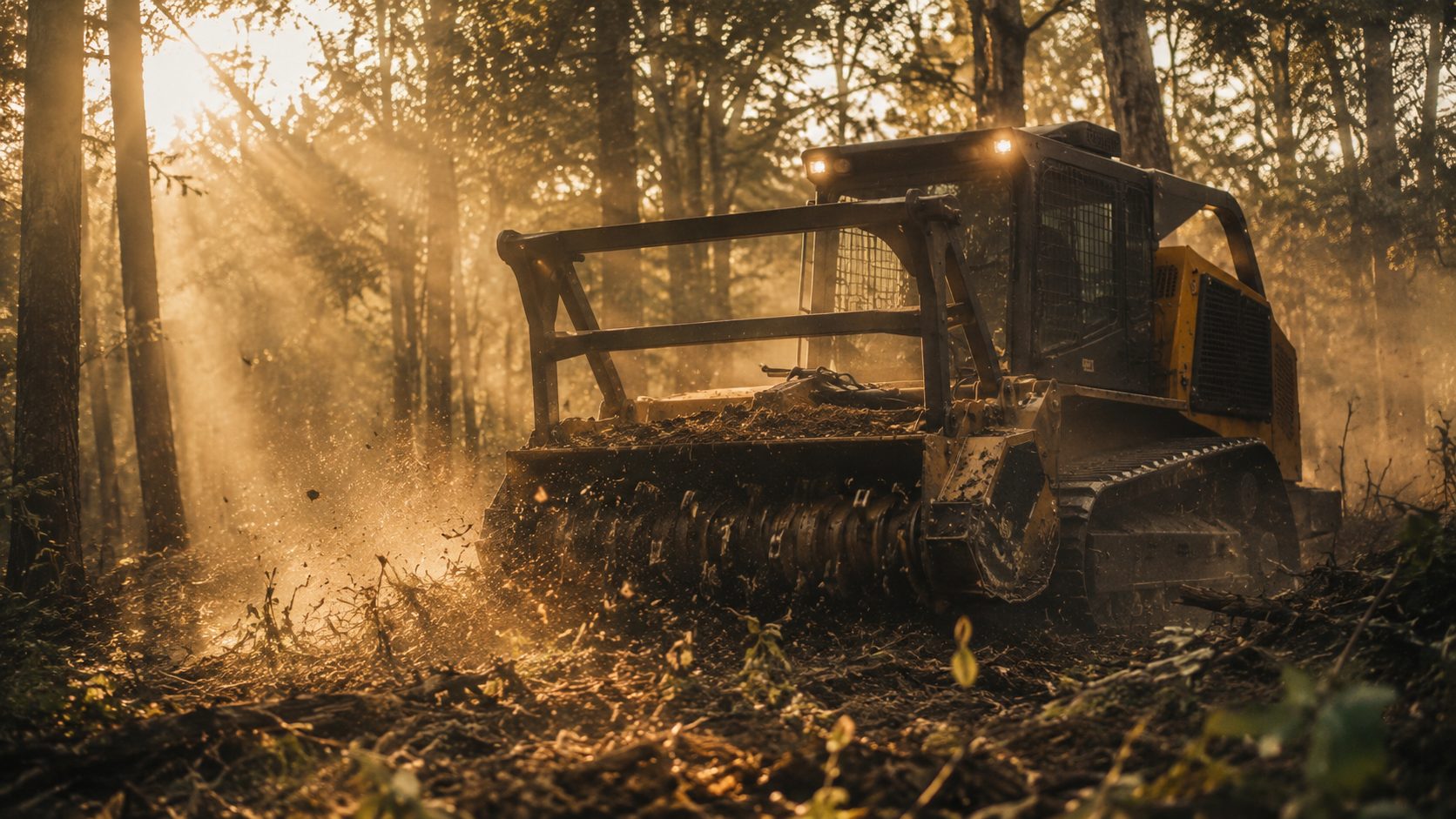
Forestry mulcher clearing brush in golden-hour forest
Fully Insured

We clear
the way.

Forestry mulching, land clearing, gravel driveways, and excavation across the Capital District of New York, the Berkshires, and southern Vermont. Honest quotes, fast turnaround, no leftover brush piles.

5% of every job goes to upstate conservation
Albany/ Saratoga/ Schenectady/ Troy/ Clifton Park/ Ballston Spa/ Mechanicville/ Greenwich/ Cambridge/ Schoharie/ Cobleskill/ Gloversville/ Johnstown/ Pittsfield/ Williamstown/ North Adams/ Great Barrington/ Bennington/ Manchester/ NORTH COUNTRY/

§ 01 — Services

Four core services.

Whether you're clearing for a new build, opening up a wooded lot, or fixing a driveway that's seen better days — we bring the right machine and finish what we start.

03 Base + grade

Gravel
Driveways

New installs and regrades with proper drainage, compacted base, and the right aggregate to last.

Get a quote
04 Site prep

Light
Excavation

Grading, light trenching, and drainage work to finish out clearing projects and keep water moving the right way.

Get a quote

§ 02 — Process

Simple. Start
to finish.

No fine print, no upsells. From first call to final walkthrough, you talk to the same crew running the machine.

  1. 01

    Reach out

    Call, text, or send the form. Tell us what you need cleared, dug, or built. and we get you a preliminary estimate.

  2. 02

    Free on-site estimate

    We walk the property, scope the job, and write up a final honest quote. No obligation.

  3. 03

    We get to work

    On schedule with the right machine. Clear, mulch, dig, or grade — fast.

  4. 04

    Walkthrough

    Final walk with you on-site. Job's not done until you're happy with it.

§ 03 — What we clear for

From back yard to back 40.

Mulching opens up land without scarring it.  Whatever you're trying to do with your property, large pasture or small back yard, we can shape the work around it.

A

Tick habitat reduction

Lyme is a real risk up here. Ticks live in brushy understory, leaf litter, and damp edges — mulching removes all three. Clearing around houses and trails cuts tick numbers.

How brush clearing reduces ticks

B

Trails: walking, ATV, UTV

Cut walking, hiking, work, ATV, or UTV trails through wooded property. Wide enough for a side-by-side, narrow enough to feel like the woods. Canopy stays for shade; only the path gets mulched.

C

Hunting land

Open up shooting lanes, clear underbrush, and create food plots. Selective mulching keeps mature mast trees and bedding cover where you want them.

Hunting habitat playbook

D

Equestrian pastures & trails

Reclaim overgrown pasture, cut bridle paths, and clear fence lines. The mulched ground is safer underfoot than stumps and stobs.

E

Fence & property lines

Knock back saplings and brush along boundaries before you run new fence — or after, to keep the line readable for years.

Backyard & fence-line guide

F

Pasture reclamation

Take grown-in fields back to grass. Mulch the brush, drop the saplings, and put usable acreage back on the map.

Invasive species in upstate NY

G

Building & cabin sites

Clear the footprint and the access road for a new home, garage, barn, or off-grid cabin without bulldozer damage to the surrounding woods.

Mulching vs bulldozing

H

Pond & lakefront access

Clear shoreline, reopen views, and cut access trails to water. Selective enough to keep the buffer the DEC asks for.

I

Right-of-way & utility

Power, gas, and easement corridors kept clear of brush and saplings without burning or hauling.

Got something not on the list? Tell us what you need — chances are we've cleared something like it.

§ 04 — Why mulching

Tired of looking
at overgrown land?

Brush piles. Burn permits. Trucks hauling debris for days. The old way of clearing land is slow, expensive, and hard on the soil. Forestry mulching does it in a single pass, which translates to less expense for you.

The old way

Traditional clearing

  • Cut, push, and pile. Crews come back for days.
  • Burn piles or trucks hauling debris off-site.
  • Heavy machines tear up topsoil and compact the ground.
  • Bare dirt left behind — prone to erosion and regrowth.

The Bison way

Forestry mulching

  • + One pass. One machine. One day on most lots.
  • + Vegetation gets ground into mulch on-site — no hauling, no burning.
  • + Lower-impact tracks leave the soil structure intact.
  • + Mulch layer protects against erosion and slows regrowth.

Eco-friendly methods

Better for the land
under your boots.

Our forestry mulching process preserves topsoil, prevents erosion, and returns organic matter to the earth. The ground is left ready to seed, plant, or build on — not scarred and bare.

01

Topsoil preserved

Tracked machines spread weight evenly. No bulldozer scars, no compaction, no torn-up root mat.

02

Erosion control

A natural mulch layer holds the soil through rain and runoff. Slopes stay stable while new growth establishes.

03

Organic matter returned

Brush, branches, and undergrowth break down in place — feeding the soil instead of filling a landfill or a burn pile.

04

Selective clearing

Mark the trees you want to keep. We work around mature growth, property lines, and sensitive areas.

05

No burn permits

Skip the paperwork, the smoke, and the fire risk. Mulching needs no open flame and no haul-off trucks.

The burn ban explained

06

Wildlife friendly

Selective mulching keeps habitat corridors and food trees standing. The land recovers faster and stays alive.

07

Lower carbon footprint

One machine, one pass. Fewer truck loads, fewer trips, fewer hours of fuel burned to finish the job.

08

Ready to plant

Cleared land comes out seedable. Pasture, food plot, lawn, building pad — mulched ground is the right starting point.

Want to see it on your property? Send the form and we'll come walk it with you.

§ 05 — Giveback

5% of every job
goes back to the land.

Bison Earthworks commits 5% of company profits, every year, to ecological and wildlife work in upstate New York — invasive species suppression, young-forest habitat for declining species, and partnerships with regional conservation organizations.

PRISM

Invasive species work

Capital Region PRISM, hosted at Cornell Cooperative Extension. Mulching capacity for barberry, buckthorn, multiflora rose, and bittersweet across the 11-county region.

DEC

Young-forest habitat

NYSDEC's Young Forest Initiative needs more early-successional acreage than the state can create alone. Selective mulching fits the playbook.

LAND TRUSTS

At-cost stewardship

Mohawk Hudson, Saratoga PLAN, Rensselaer Land Trust, Berkshire Natural Resources Council. Plans without budgets get equipment time.

Read how the 5% works

The 5% comes out of company profit — not your invoice. No upcharge, no opt-in. Annual public report at the close of each fiscal year.

§ 05 — Why Bison

The crew you call when you want it done right.

Bison is locally owned and run out of the Capital District. We're not a dispatch — when you call, you talk to the people running the machines.

Start a project
  • +

    Locally owned & operated

    Born and raised in the Capital Region — we know the soil, the seasons, and the towns.

  • +

    Fully insured

    Full general liability. Certificate of insurance available on request.

  • +

    Free on-site estimates

    We walk your property in person and give you a written quote — no obligation.

  • +

    Show up on time

    Scheduled is scheduled. We bring the right machine the first time, every time.

§ 06 — Common questions

FAQ

How much does forestry mulching cost? +

Most projects price by the acre or by the hour, depending on density. Light underbrush runs faster (and cheaper) than heavy mature growth, and access matters too — a tight backyard takes longer than open acreage. Every customer gets a free on-site estimate so you have a real number before committing, not a phone guess.

How long does a typical job take? +

A small residential lot is usually a single day. Larger acreage, dense mature growth, or multi-stage projects can run a few days to a week. We give you a clear timeline along with the estimate so you can plan your week around it.

What size trees can you mulch? +

Our mulchers handle brush, saplings, and trees up to roughly 8 inches in diameter (measured at chest height) without slowing down. Bigger than that, we combine mulching with stump grinding or fell-and-process — tell us what's on the property when you call and we'll bring the right setup. Density of growth usually drives the timeline more than the size of any one tree.

How many acres can you clear in a day? +

Light to moderate brush — figure a couple of acres per day. Mature woodlots, heavy underbrush, or thick invasives can drop that to a half-acre or less. We'd rather be honest about pace than oversell, so the estimate spells out what you'll see at the end of each day on bigger jobs.

Do you handle stumps and large trees? +

Yes. For full land clearing we remove stumps and large trees with the right combination of mulching, grinding, and excavation. Just let us know what's on the site when you call so we can plan the equipment.

What's the difference between forestry mulching and traditional clearing? +

Forestry mulching grinds vegetation into mulch on-site in one pass — no burn piles, no haul trucks, no torn-up topsoil. Traditional clearing pushes everything into piles for burning or hauling, which takes more days, more equipment, and leaves bare scarred ground behind. Mulching is faster, cleaner, and the resulting layer protects the soil instead of exposing it.

Will the brush grow back? +

Some regrowth is normal — that's how the woods work. The mulch layer suppresses new seedlings, but invasive root systems like Japanese knotweed, multiflora rose, and bittersweet will push back through and need follow-up over two or three seasons to really knock down. We'll tell you what one pass will and won't do for the species on your property.

What happens to all the mulch? +

It stays on-site as a 2 to 4 inch ground cover. As it breaks down over the next year or two, it returns nutrients to the soil, holds moisture, and protects the ground from erosion. If you'd like it raked into trail beds, garden paths, or piled up for landscaping, just say the word at the walkthrough — that's part of the job, no extra ask.

Can I keep specific trees? +

Yes — selective clearing is most of what we do. Walk the property with us at the estimate and mark anything you want kept (ribbon works fine). Mast trees like oak and hickory, shade trees, screening pines, edge cover for wildlife — all common keepers. We confirm before the machine starts.

Can you work on slopes or rocky ground? +

Tracked equipment with low ground pressure handles most of the slopes and rough terrain we see across the Capital District, the Berkshires, and southern Vermont. Very steep grades or extensive ledge may need a different approach — we'll tell you on the walkthrough whether the job is something we can run safely or whether to bring in a partner.

Do you work year-round? +

Yes — all four seasons. Winter is often the best time to clear: frozen ground means lower impact on the soil, leaf-off makes the work obvious, and the schedule is more open than spring rush. Mud season — usually late March into early April — is the only stretch we tend to avoid for access reasons.

Are you insured? +

Yes — we carry full general liability coverage. Certificate of insurance available on request, and we're happy to name an additional insured for commercial or HOA jobs that require it.

What areas do you serve? +

Albany, Saratoga, Rensselaer, Schenectady, Schoharie, and Fulton counties in NY, plus Berkshire County, MA and Bennington County, VT. Outside that area? Call us — we may still be able to help on larger jobs.
§ 07 — Get an estimate

Ready to clear the way?

Call, text, or send the form. We'll get back to you within the same business day.

  • PHONE (TEXT OR CALL)

    (518) 288-8120
  • Email

    info@bisonearth.com
  • Hours

    Mon–Sun · 9am – 6pm

  • Service area

    Albany · Saratoga · Rensselaer · Schenectady · Schoharie · Fulton (NY) · Berkshire (MA) · Bennington (VT)

Free estimate

Tell us about the job.

What do you need? (select all that apply)

OR JUST CALL/TEXT (518) 288-8120