Bison Earthworks / Education
Clearing an overgrown backyard
or fence line.
A “back yard” can mean a quarter acre of lawn behind a Colonie ranch or five acres of overgrown fence line in Brunswick that hasn't been touched since 1995. Both are real, both are common in the Capital District, and both can be reclaimed without the kind of teardown people fear.
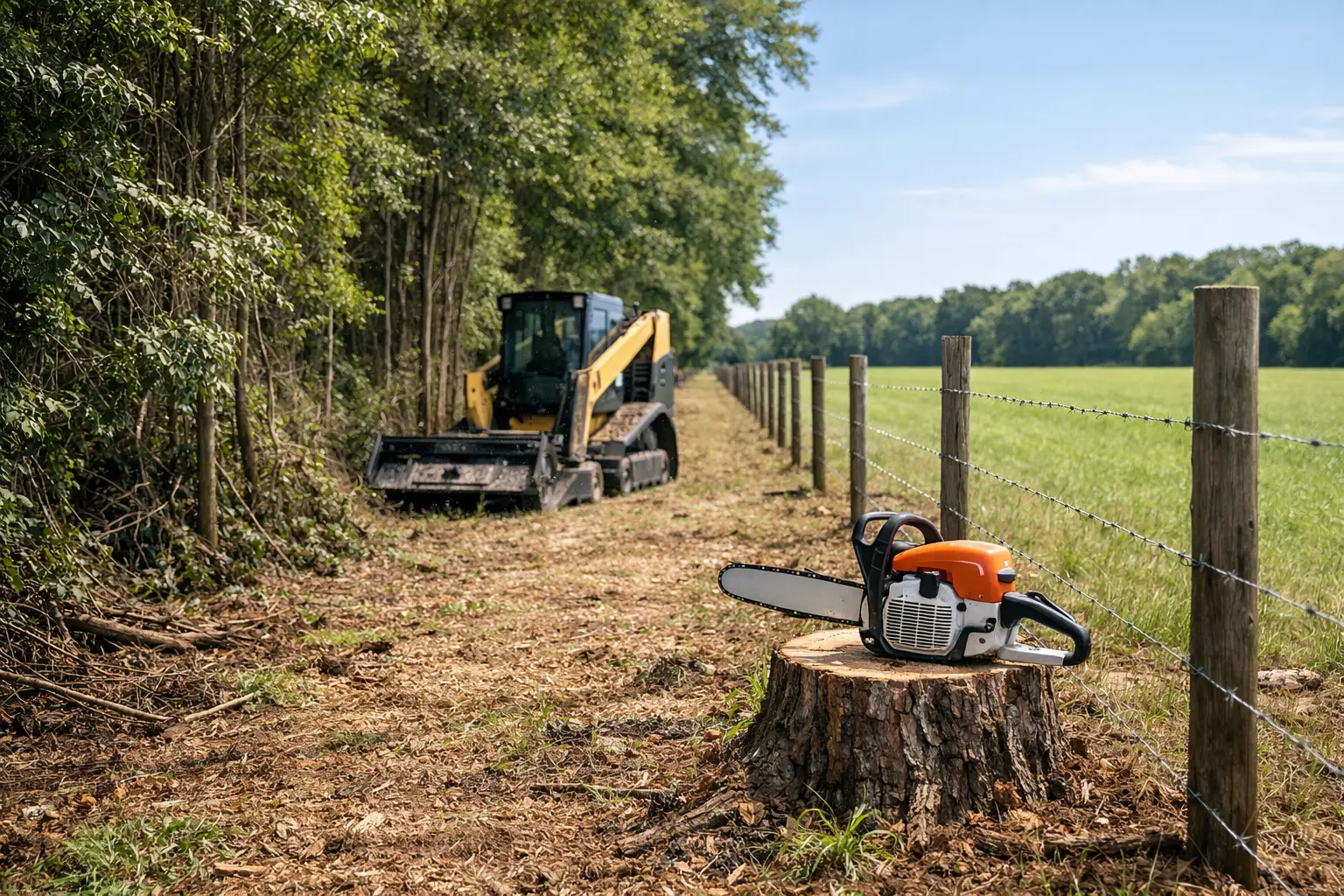
The fastest way to make a brushed-in property feel useful again is selective forestry mulching. The slowest is one weekend at a time with a chainsaw and a brush hog. Most owners trying the second route give up before the property is back. Here's what the first route looks like in practice.
Start with a walkthrough
Before any equipment shows up, the property gets walked end to end with the owner. The point is to figure out three things: what's actually growing, what should stay, and what the access looks like.
The first item is more interesting than it sounds. After ten or fifteen years untouched, a back yard or fence line in upstate NY tends to fill in with a predictable cast of characters. Recognizing them changes how the work gets planned.
What's usually growing back here
Common reclaimers in the Capital District, the Berkshires, and southern Vermont:
- Multiflora rose — the dense, thorny mound that scratches anyone who gets near it. Originally promoted as a "living fence" in the 1930s, now considered invasive in nearly every state where it's established.
- Oriental bittersweet — the orange-berried vine that climbs up trees and slowly strangles them. The vines you see twisting through the canopy along most rural roads up here are usually this.
- Glossy and common buckthorn — small trees with smooth dark bark and oval leaves. Aggressive seed-spreaders, often the dominant understory in old field edges.
- Autumn olive — silvery-leaved shrub, originally planted for wildlife, now invasive. It actually fixes nitrogen and changes the soil chemistry in ways that favor more invasives.
- Japanese barberry — small spiny shrub with red berries and bright yellow inner wood when cut. Bonus problem: research has linked dense barberry stands to higher tick populations, which is a separate article.
- Norway maple seedlings — cousin of the sugar maple but more shade-tolerant and faster-growing. Crowds out native saplings and dominates understories near old plantings.
- Sumac — native, valuable for wildlife, but spreads aggressively into open ground. Often kept in patches rather than removed entirely.
- Brambles — blackberry and raspberry. Tangled, thorny, and frankly useful — they hold soil and feed wildlife. Whether to keep some patches usually comes up at the walkthrough.
What gets marked to keep
Most properties have at least a few keepers worth working around. Common ones:
- Mature shade trees near the house, road, or play area.
- Anything providing screening from the neighbors. Pines, hemlocks, and dense shrubs along sight lines.
- Mast trees — oaks, hickories, beech — even mid-sized specimens that'll mature into food sources for wildlife.
- Native flowering shrubs along edges. Witch hazel, viburnum, dogwood, hazelnut. These tend to have already lost the competition with invasives, and a careful pass gives them room.
- Anything sentimental — the apple tree the kids climbed, the dogwood the previous owner planted. People know what they're attached to. We mark and avoid.
A roll of pink or orange flagging tape is enough. Tie a ribbon at chest height on what stays, and the operator can read it from inside the cab.
Calling before digging
Forestry mulching doesn't dig — the machine works on top of the ground — but if the job involves any grading, regrading, or a pass with an excavator (driveway shoulders, drainage ditches, removing a buried stump), NY 811 has to be called first. State law in New York requires excavators to give utility companies 2 to 10 working days' notice before any digging. Vermont and Massachusetts have parallel rules through Dig Safe.
Marks last about ten working days. They're free to a homeowner, the call takes a few minutes, and the fine for a violation that hits a buried gas or electric line starts at $1,000 for a first offense in NY. If the work plan includes any earth moving, this gets done before scheduling.
Things to flag for the marker visit: water lines to outbuildings, leach fields, electric runs to a barn or pool, propane lines from house to tank, irrigation, invisible-fence loops. Property owners often forget one of these; we ask anyway.
Fence-line specifics
A fence line job has its own quirks. The fence itself is usually still in there somewhere — barbed wire wrapped into trees, posts that became part of the woods, sometimes a remnant of woven wire from forty years ago. Three things to check before clearing:
- Whose fence is it. If it's a shared boundary, both neighbors get a heads-up. We've never had a real dispute over this, but a five-minute conversation prevents one.
- Easements and right-of-way. Utility easements often run along fence lines. The easement holder may have rights to vegetation management you should know about.
- The condition of the fence. If it's still doing its job, we work to one side and leave it. If it's failed, mulching can clear the line and a new fence goes in cleaner without the old wire to dodge.
Day-of expectations
A small backyard job is usually a half day. A long fence line on a few acres can run a full day or two. The machine is loud — chainsaw-grade, not louder. Neighbors notice; a heads-up the day before is courteous.
Equipment access matters. A typical compact mulcher needs about 7 to 8 feet of clearance to get back. For tight residential lots, that means we may bring a smaller stand-on or skid-steer-mounted unit instead of a full-size machine. The estimate visit answers this.
If the reason for clearing is that the property is going on the market, the work is worth scoping a little differently — sightlines, driveway, and building envelope matter more than total acreage cleared. The prep-for-sale piece covers what to prioritize.
After the work
Two to four inches of mulch on the cleared ground. The keeper trees standing where you marked them. The fence line readable for the first time in years. From there, you've got two paths:
- Lawn or pasture. Broadcast cool-season grass seed in early fall, lightly rake to expose 30–50% of the soil, and the new grass comes in through the mulch with the chips acting as moisture retention. For larger fields, the hayfield reclamation piece covers the multi-year version.
- Let it go to woods edge. Native regeneration will fill in over two or three seasons. Walking the area once a year with loppers takes care of any reinfestation by invasives that try to reseed.
Either way, the mulch layer is doing useful work in the background — feeding the soil, holding moisture, and suppressing the early weed flush that always tries to colonize freshly cleared ground.
Maintenance, going forward
Reclaimed property doesn't reclaim itself again unless someone keeps an eye on it. The realistic schedule for most yards and fence lines:
- Year one: watch for invasive resprouts. Any knotweed, multiflora rose, or bittersweet pushing back through gets cut or treated before it establishes.
- Years two and three: a single brush-hog pass each summer, or a light selective mulching pass every other year, keeps things readable.
- Long term: annual spring walk with loppers and a saw. Most of the heavy lifting was the first pass.
A property that was untouched for fifteen years will still be readable five years from now if it gets a few hours of attention each season. The hard part is the first pass. After that, it's gardening.
Walk your property with us
Wondering what's worth keeping and what isn't on your land?
Free on-site estimates across Albany, Saratoga, Rensselaer, Schenectady, Schoharie, Fulton (NY), Berkshire (MA), and Bennington (VT) counties. We'll walk it with you, talk through the trade-offs, and tell you straight whether mulching is the right approach for what you want to do.