Bison Earthworks / Education
Mulching vs bulldozing:
when each makes sense.
The two get pitched as competitors. They're not. They do different jobs, and a cleaner fit between need and tool decides which you should be hiring — sometimes both.
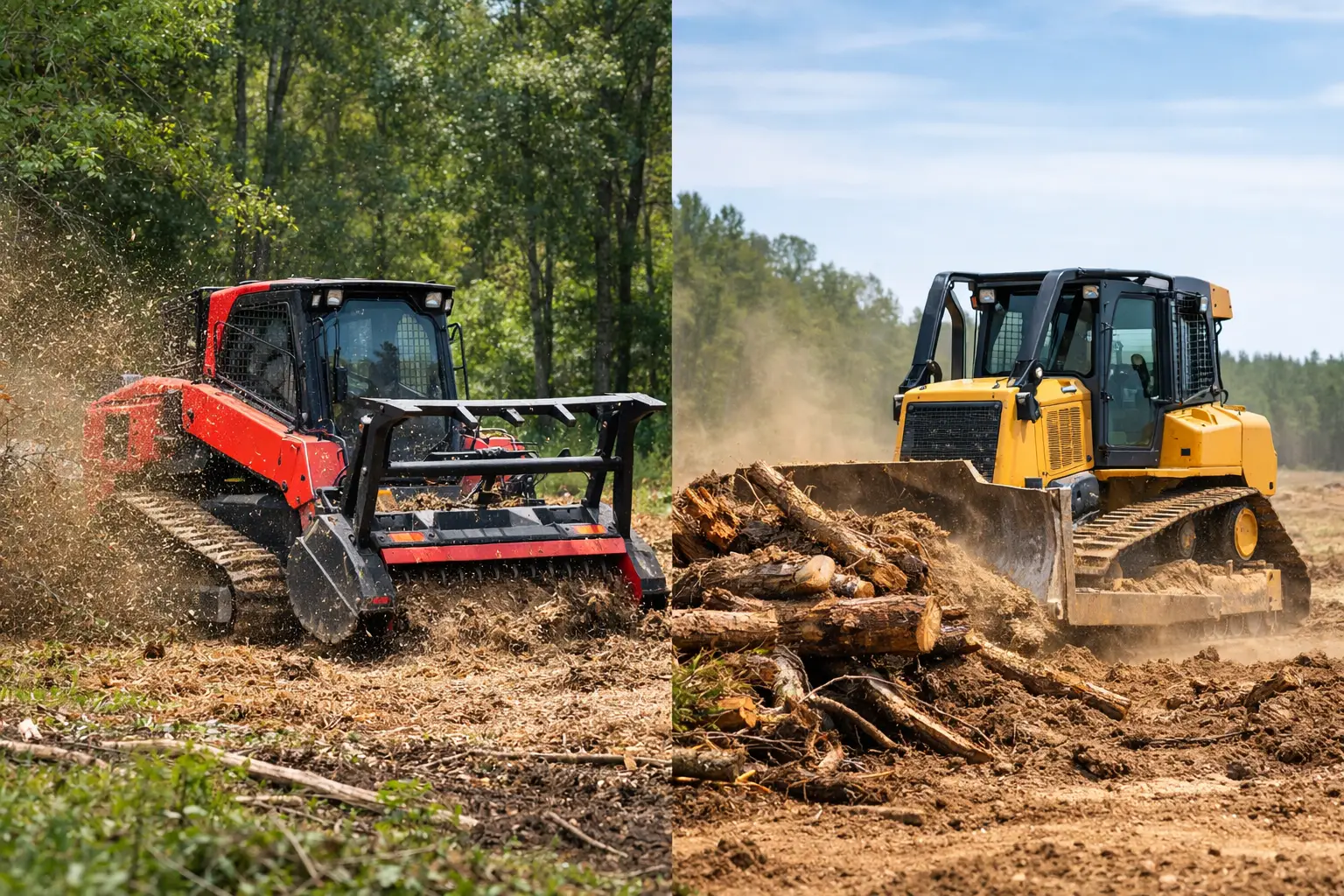
A forestry mulcher and a bulldozer end up at the same property for different reasons. Knowing which one a job actually wants — or whether it wants both, in sequence — is most of what separates a clean result from a dragged-out one. Here's an honest comparison.
What each machine actually does
A forestry mulcher is a tracked carrier (skid steer, compact track loader, or dedicated forestry machine) with a rotating drum head full of carbide teeth. The drum spins fast and chews standing material — brush, saplings, small trees — into chips that fall onto the soil. The machine works on top of the ground. It doesn't dig, doesn't push earth, doesn't grade. The cleared area is left with the original soil profile intact, plus a 2 to 4 inch chip layer on top.
A bulldozer is a tracked machine with a steel blade. Its job is moving earth — pushing topsoil, ripping stumps, scraping a building pad, cutting and filling for a road or driveway. Dozers handle vegetation by knocking it down and pushing it into piles, then either burning the piles or hauling them off. The cleared area is bare soil at the end, often regraded.
Different tools, different outputs. Both useful.
Ground pressure — what's under the tracks
The single biggest physical difference between the two is what they do to the soil while working.
A forestry mulcher's tracks are wide for the machine's weight. Ground pressure for typical forestry mulchers runs around 5 to 8 PSI — comparable to or less than the pressure your work boot puts on the soil while walking. The machine "floats" across the surface; soil structure underneath is largely undisturbed.
A standard bulldozer is heavier and has narrower steel tracks. A Cat D8 standard track-type dozer exerts about 13 PSI. Low-ground-pressure (LGP) variants of the same machine drop to around 8 PSI — better, but still firmer than a mulcher. Once the dozer starts cutting, ripping, or pushing piles, the dynamic loads in spots go much higher than the static rating.
Why this matters: compacted soil drains worse, loses pore space for roots, and takes years to recover. On a property where the soil profile matters — a future pasture, a working woodlot, a habitat zone, anywhere you want plants to grow well after — the mulcher leaves the ground in a state that supports growth. The dozer leaves it in a state that needs amendment and time.
When mulching is the right call
The list of jobs that fit a forestry mulcher cleanly:
- Selective clearing. Anywhere you want some trees kept and others removed. Mulchers can work tree by tree.
- Brush, saplings, and small trees. Material up to about 8 inches in diameter is the sweet spot. Larger material slows the machine.
- Fence lines and property edges. Long narrow corridors are well-suited to mulching.
- Right-of-way maintenance. Power, gas, easement clearing — recurring work where the goal is keeping woody growth back without disturbing the corridor.
- Hunting and habitat work. Trails, food plot prep, shooting lanes, edge habitat.
- Reclaiming overgrown lots. Yards, pastures, and woodlots that grew in over a decade.
- Pond-side and wetland-adjacent clearing. Where soil disturbance is regulated or undesirable. The DEC wetlands and streams piece covers what's regulated and what isn't.
- Steep wooded slopes within the machine's safe operating range. Lower ground pressure means less rutting, less erosion.
For all of these, the mulcher does the whole job and leaves the ground in usable shape.
When bulldozing is the right call
Different list, different jobs:
- Building pads. A foundation requires bare graded soil, not a mulched surface. Dozer territory.
- Driveways and access roads. Cut-and-fill work, sub-base prep, drainage shaping. Dozer. (Corridor clearing for the driveway is mulcher work; structural base is excavation work — covered in the long driveway piece.)
- Stump removal. Mulchers can grind tops of stumps but don't pull them out. A dozer (or excavator) does.
- Pond construction. Excavating the basin, building the dam, shaping the spillway. Excavator and dozer work, not mulcher.
- Major regrading. Anything where the goal is moving large quantities of earth.
- Full-clear demolition sites. When the entire property needs to go to bare graded soil for development.
Trying to do these with a mulcher is the wrong tool. A dozer gets there faster and produces the right end state.
When you actually need both
A lot of building and development jobs combine the two in sequence:
- Forestry mulcher clears the standing brush and small trees on the building footprint and access corridors. The resulting surface is mulched ground with stumps still in place.
- Excavator or dozer comes in, pulls stumps, hauls them, grades the building pad, cuts the driveway sub-base.
- Final shaping and base prep for foundation, drainage, septic, etc.
This sequence is faster and cheaper than asking the dozer to do everything. The mulcher gets through brush at a pace the dozer can't match, and it leaves the bigger material and the sub-grade work for the right machine. On most new-construction lots in the Capital District, this two-step approach is the default for any wooded property going to development.
Cost framing
Hard rules without seeing the property are unreliable, but rough orientation:
- Forestry mulching is usually priced per acre or per hour. Light brush runs faster (and cheaper); dense growth or large material slows things down.
- Bulldozing is usually priced per hour, with hauling and disposal as separate line items if material has to leave the site.
- For a brush-only job, mulching is typically less expensive than dozing the same area, because the dozer ends up doing two jobs (knocking down and piling/hauling) instead of one.
- For a job that needs grading anyway, it's usually cheapest to mulch first, then dozer second, rather than dozer-only.
- Burn pile disposal is often the hidden cost of dozer-only clearing once you account for permit time and burn-day weather waits.
Time framing
Per-day production rates depend heavily on conditions, but rough numbers:
- Forestry mulcher in moderate brush: 1–2 acres per day.
- Forestry mulcher in heavy mature understory: half an acre to one acre per day.
- Bulldozer doing full-clear with stump push-and-pile: typically slower than that, especially on wooded acreage with significant stumps.
- Combined mulching + dozer sequence on a 2-acre building lot: usually 2–4 days total, depending on grading scope.
The summary
Mulchers and bulldozers aren't substitutes. The mulcher is a precision tool for selective clearing that leaves the ground intact. The dozer is an earth-moving tool for jobs that end in graded bare soil. Most properties need one or the other. A meaningful share of building and development jobs need both, in that order. Picking the right tool — or asking the contractor to bring both, in sequence — is the difference between a job done cleanly the first time and one that backtracks on itself.
Walk your property with us
Wondering what's worth keeping and what isn't on your land?
Free on-site estimates across Albany, Saratoga, Rensselaer, Schenectady, Schoharie, Fulton (NY), Berkshire (MA), and Bennington (VT) counties. We'll walk it with you, talk through the trade-offs, and tell you straight whether mulching is the right approach for what you want to do.