Bison Earthworks / Education
Reclaiming a hayfield
that went to brush.
A common Capital District story: grandfather kept the hay coming off the back ten acres until he couldn't, then the field sat. Twenty years later it's a wall of poplar, autumn olive, and multiflora rose. Mulching pulls it back to grass without scraping topsoil to bedrock.
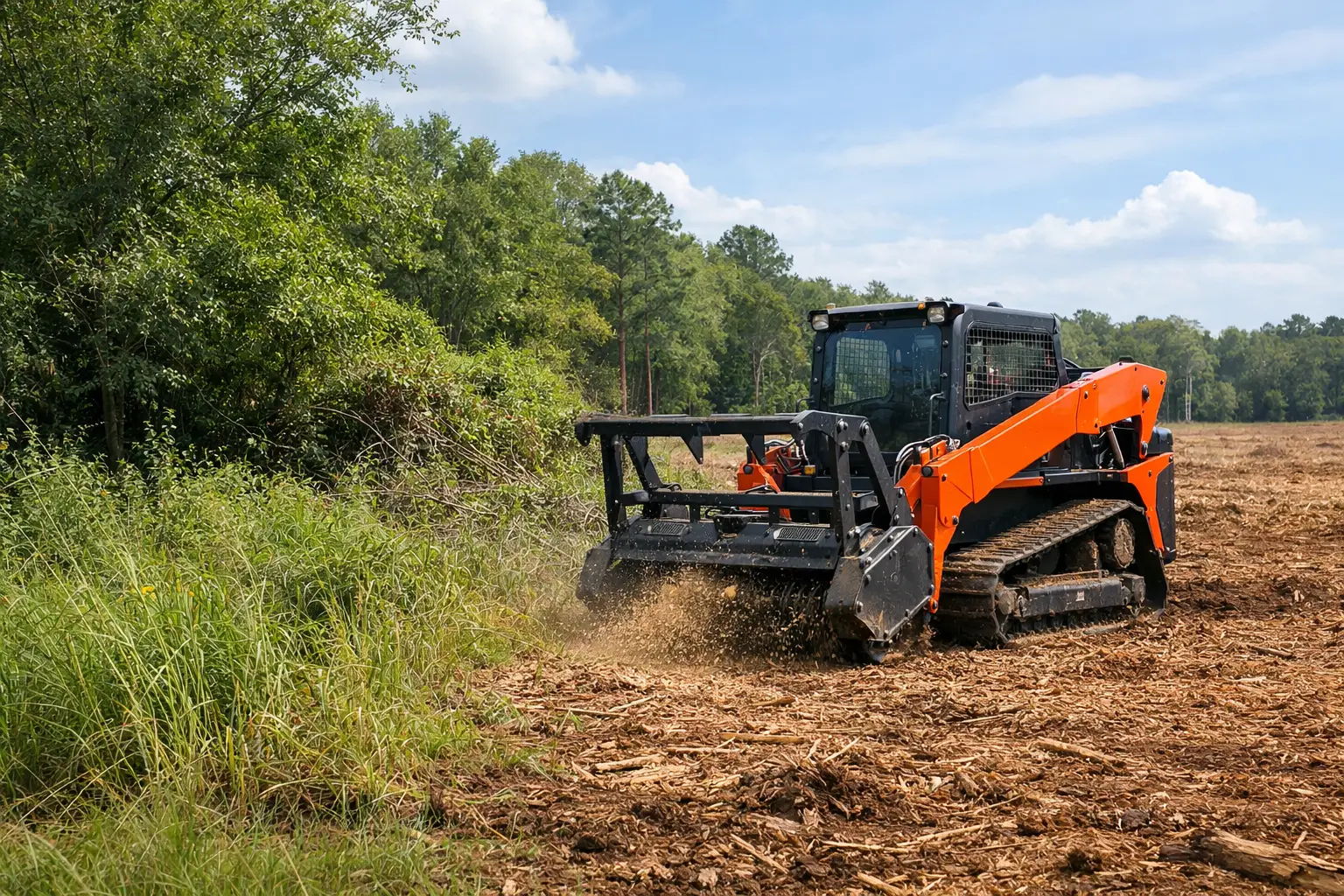
The owner — grandson, niece, new buyer — wants the field back. The standard impulse is to call somebody with a bulldozer. Mulching is the better tool for most of these jobs, for reasons that have more to do with soil than with brush.
What grows in after the haymaking stops
An old hay field abandoned in upstate NY, the Berkshires, or southern Vermont fills in a predictable sequence. Knowing what you've got tells you what the recovery is going to look like.
Years 1 to 3: goldenrod, asters, milkweed, briars on the edges. The field looks weedy but the root mat is still intact. A brush-hog pass takes care of this — no mulcher needed.
Years 3 to 8: shrub layer establishes. Sumac, dogwood, hawthorn, multiflora rose, autumn olive, honeysuckle. The first saplings start punching through — gray birch, aspen, white pine, the occasional red cedar. A brush-hog can still keep up if it goes through annually. Two years skipped and it can't.
Years 8 to 15: the saplings are now trees. Poplar and aspen at 4 to 6 inches diameter at breast height, gray birch the same, red maple opportunistically taking the better soils. Multiflora and bittersweet form thickets in the openings. Walking through is hard, mowing impossible. This is the sweet spot for forestry mulching.
Years 15 to 25: closed canopy is forming. The pioneer trees — poplar, gray birch — start senescing, and shade-tolerant species like red maple, black cherry, and sugar maple in good sites are pushing through. Now you're not reclaiming a field; you're managing a young forest. A different conversation, covered in part by our forest-health piece and, for larger parcels, the 480-a tax law piece.
Most reclamation projects we see are at year 12 to 18. Long enough for the saplings to be real, short enough that the soil under the canopy is still field soil rather than forest soil.
Why bulldozing is the wrong tool
The reflex on a brushed-in field is to push everything to a corner with a dozer and pile-burn it. We cover the broader case in mulching vs. bulldozing, but for a hayfield specifically the math is unkind:
- Dozers strip the topsoil that took a few generations to build. Hayfield topsoil is the most valuable inch on the property.
- Burning or hauling piles costs days and money beyond the initial clearing.
- Bare ground after a dozer push is a perfect colonization site for the same invasives you just removed. Bittersweet seed sits viable in the soil for years; expose it and it comes back.
- Compaction from dozer tracks reduces water infiltration and shifts the soil chemistry. Replanted hay or pasture seed germinates worse on compacted ground than on undisturbed ground.
A mulched field, by contrast, keeps the topsoil where it is, returns the brush to organic matter on-site, and leaves a chip layer that suppresses the early weed flush. The seeded grass comes up through the chips, with the chips acting as moisture retention. By the second growing season, the field reads as field again.
What mulching does to a field-going-to-woods
A typical pass on a 5-to-10-acre brushed-in hayfield in our service area:
- Pioneer saplings — poplar, aspen, gray birch — up to 6 to 8 inches DBH go down in one pass with the mulcher head.
- Shrub layer — multiflora rose, autumn olive, honeysuckle, dogwood — gets ground into the chip layer.
- Native edges — clumps of dogwood, viburnum, hazelnut along the woods boundary — get flagged and saved if the owner wants them.
- Stumps remain in the ground at chip-level grade. They rot in place over three to seven seasons.
- Larger trees, 10+ inches DBH, get flagged for either retention (mast trees, shade trees) or a separate fell-and-process step. The mulcher isn't the right tool for the big stems.
Chip depth on a hayfield job is typically 2 to 4 inches, sometimes deeper in spots where multiple shrubs were stacked. The mulch-layer piece covers what happens to those chips chemically and biologically; the short version is they decompose into the topsoil over 3 to 5 years.
Reseeding strategies
How fast you get back to grass depends on what kind of grass and how much prep you want to do.
Cool-season pasture or hay mix. The most common goal. Recommended timing is late summer — August 15 through mid-September in our region — broadcast or drilled into the mulched ground. Light raking to expose 30 to 50% of the soil works for broadcast seed. For a real hay stand, a no-till seeder pulled by a tractor gives the best germination.
Warm-season native grasses. Big bluestem, indiangrass, switchgrass. Useful for wildlife or where soils are poor. These prefer late spring seeding — mid-May through mid-June — with stratified seed. Slower to establish; usable stand in year three.
Pollinator mix. Some landowners want a mix of native forbs and grasses rather than pure hay. Regional native-seed suppliers (Ernst Seeds, Roundstone, NY-specific mixes through Cornell Cooperative Extension) offer Capital District-appropriate blends.
In all cases, the chip layer helps rather than hurts germination. Seed sown into the chips and lightly worked drops down to the soil through the chip gaps. The moisture retention of the chip layer keeps it from drying out, and the broken-down chip starts feeding the new grass within the first year.
Realistic timeline
Year by year on a typical reclamation:
- Year 1. Mulched. Chips on the ground. Seed goes down in fall if the job was summer; spring or fall if the job was winter. By the end of the first growing season, 60 to 80% groundcover by the new grass plus some volunteer weeds and goldenrod.
- Year 2. First cutting if it's a hay field. Stump grade is visible; everything else looks like field. Annual brush-hog pass through any patches where invasives are trying to come back.
- Year 3. Field is field. Stumps still present but flush with grade. Maintenance: one brush-hog pass, scout for invasive resprouts.
- Years 4 to 7. Stumps rotting out. Brush-hog or hay equipment running over them without issue. The mulch layer is fully decomposed and the topsoil has gained an inch or so of new organic matter.
- Year 8 and beyond. No evidence the field was ever in woods. The property is back to its original use, with better soil than when it started.
This assumes maintenance. A reclaimed hayfield walked away from for five years is well on the way back to where it was. The work is keeping the gain, not redoing the project. Invasive control over the first three years is the part most owners underestimate; the invasives piece covers the species and the realistic schedule.
Where this doesn't fit
Honest limits:
- Mature forest. If the parcel is now 25+ year old hardwoods, you don't have a hayfield; you have a young forest. The decision is whether to keep it as woods or convert it, which is a bigger conversation than this article.
- Wet ground. A field that was mowed historically but is now wet enough to support cattails and wet-meadow species may be a regulated wetland under current rules. DEC wetland rules apply.
- Very large stems. A 15-inch DBH oak that grew up in the corner of the field is a tree, not brush. We work around it (and usually recommend keeping it).
- Slopes that won't hold seed. Steep field edges with poor soils may not re-establish to grass easily. Sometimes the better answer is to let those edges go back to woods.
- Tick-heavy edges. Where the field meets the woods, the brushy gradient that ticks need can be intense. Worth combining the reclamation with edge-zone tick mitigation — covered in the tick habitat piece.
The summary
An overgrown hayfield is one of the cleaner cases for forestry mulching. The work fits — knockdown of shrub and sapling layers without disturbing the underlying soil structure — and the recovery is fast because the land remembers being a field. Most year 12-to-18 hayfields go back to usable ground in two growing seasons. Invasive control over years 1 through 3 keeps the gain. Maintenance after that is brush-hog frequency, not bulldozer frequency.
Walk your property with us
Wondering what's worth keeping and what isn't on your land?
Free on-site estimates across Albany, Saratoga, Rensselaer, Schenectady, Schoharie, Fulton (NY), Berkshire (MA), and Bennington (VT) counties. We'll walk it with you, talk through the trade-offs, and tell you straight whether mulching is the right approach for what you want to do.