Bison Earthworks / Education
What's actually doing the work:
a guide to the equipment.
When a forestry mulching crew quotes a job, you're paying for a specific machine with specific capabilities. Knowing what those are — base machine, head type, hydraulic flow — is the difference between an apples-to-apples comparison and a price war where the lowest bidder shows up with the wrong tool.
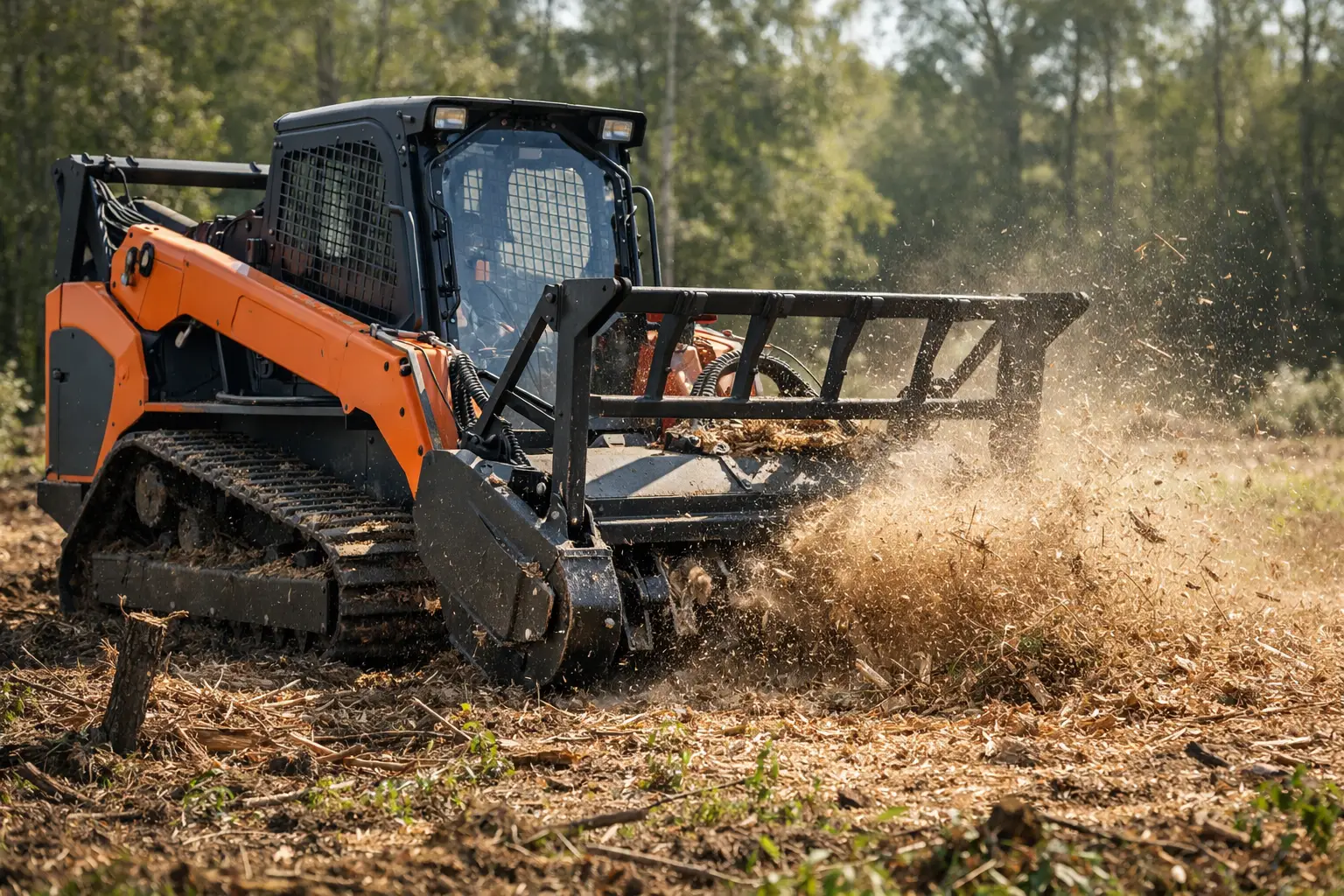
Most landowners getting a forestry mulching quote have never actually seen one of these machines work. The category covers a wide spread of equipment and capability. A few definitions go a long way when comparing contractors and reading proposals.
Two parts: base machine plus head
Every forestry mulching setup is a base machine — the carrier with the engine, hydraulics, and operator cab — plus an attachment, which is the mulching head itself. Both matter. A small head on an oversized base machine wastes the carrier. A big head on an underpowered base machine can't get enough hydraulic flow to do real work and will overheat, lug, or simply stall on hardwood.
Base machine — Compact Track Loader (CTL)
The most common base machine for residential and small commercial forestry mulching. Rubber tracks, around 100 horsepower, 8,500 to 13,000 lbs operating weight.
Common examples: Cat 299D3 XE, Bobcat T86, Kubota SVL97-2, ASV RT-135 Forestry, Takeuchi TL12V2. The "forestry" or "XHF" variants are the ones built specifically for this work — they come from the factory with extra cooling capacity, premium hydraulics, and forestry-spec guarding.
Strengths: very low ground pressure (3 to 5 PSI on rubber tracks — about the same as a person walking), excellent maneuverability, can work close to structures and ornamental keepers, fits on a standard tilt-deck trailer for transport.
Limits: the head is mounted 3 to 6 feet in front of the operator, so reach is short. Can't efficiently mulch tall standing material (over about 20 ft) from a single position — has to drive into the stand and process from inside.
Best for: residential clearing, fence lines, food plots, brush thickets, woodland understory selective work, hunting trail networks.
Base machine — Excavator-mounted mulcher
A track or wheeled excavator (typically 8 to 20 ton) with a mulcher head mounted on the end of the boom in place of the bucket.
Common examples: Cat 308 / 313 / 315 / 320 with a Fecon or FAE excavator-mount head; Kubota KX080 with similar. Some operators run dedicated combo machines (e.g. Prinoth Raptor) built for this duty from the factory.
Strengths: long reach (20 to 30 ft), can mulch outward from a stationary position. Useful on slopes, wetland edges, or stream banks where the carrier shouldn't move much. Strong on vertical work — mulching up a tall thicket or hedge without driving into it.
Limits: higher ground pressure than CTL, harder to fit in tight residential spaces, slower acres-per-hour on open ground. The boom geometry trades production speed for reach.
Best for: ROW maintenance from a road shoulder, fence lines along ditches, wetland-edge clearing, hillside work where the carrier stays put.
Base machine — Purpose-built forestry tractor
Tracked carriers built specifically for industrial-scale mulching: Tigercat 480/470, Fecon FTX150, Prinoth Raptor/Panther, the JCB X Series Forestry. Engines from 150 to 300+ HP, operating weights 20,000 to 45,000 lbs, designed to run a mulcher head at full duty cycle for an entire shift.
Most landowners will never see one of these on a residential job — they're priced and routed for commercial cycle work, utility ROW contracts, military and government land management. For context: a Tigercat 480 with a mulcher head retails in the high six figures. The economics only work at industrial scale.
Head — Drum mulcher
A horizontal cylindrical rotor (imagine a fat rolling pin) covered in carbide-tipped teeth or planer-style blades. The drum rotates at high RPM and processes brush by pulling material into a downward sweep.
Variations include fixed-tooth designs (Fecon's "Bull Hog" line is the production standard, with replaceable carbide teeth) and movable-tooth designs (Denis Cimaf, FAE) where the teeth retract on rock strikes to protect the rotor.
Strengths: very fast on saplings and small stems (under 6"), produces a moderately coarse mulch, less prone to flying debris because the drum's geometry directs material downward.
Best for: high-production clearing of brushy understory, fence lines, woodland thickets where speed matters more than fine particle size.
Head — Disk mulcher
A vertical disk — picture a heavy circular saw blade — with carbide teeth around the perimeter. The disk spins on a horizontal axis and cuts more like a vertical brush hog blade.
Common examples: Diamond Mowers DDM disk mulcher line, FAE DML.
Strengths: finer mulch product, more aggressive on larger material (6 to 10" stems), excellent for selective work because the operator can pick individual stems with the edge of the disk without disturbing surrounding material.
Limits: more flying-debris risk (operators run extra side shielding), slightly slower on dense low brush than a drum on the same machine.
Best for: selective forestry work, wildfire prevention thinning, hunting plot prep, jobs where individual trees get picked or where finer mulch matters.
Hydraulic flow — the spec most people ignore
Mulching heads run on the base machine's hydraulics. Flow rate (gallons per minute) and pressure (PSI) determine how much torque the head produces, which determines what it can cut.
- Standard flow CTL: 18 to 23 GPM at 3,500 PSI. Adequate for light brush only. Will struggle on hardwood saplings over 3" diameter.
- High flow CTL: 30 to 40 GPM. The practical minimum for serious forestry mulching. Most commercial mulcher heads specify this minimum flow.
- Super-high / XHF flow: 40+ GPM. Premium CTL class (Cat 299D3 XE, Bobcat T86, ASV RT-135 Forestry). Best production output on the toughest material.
Why this matters as a buyer: a contractor quoting a forestry mulching job with a standard-flow skid steer is bringing the wrong machine to a hardwood job. The work might get done eventually, but it'll be slow and the price reflects the inefficiency — or worse, the contractor underbids because they don't know what they're walking into. Always ask about base machine and flow rate.
Fuel use
- CTL with mulcher head, production work: 4 to 7 gallons of diesel per hour.
- Excavator-mounted setup: 5 to 9 gph depending on machine size.
- Purpose-built forestry tractor: 10 to 15+ gph.
At roughly $4 per gallon diesel, fuel alone runs $20 to $35 per machine-hour on a CTL setup. Worth knowing because it's a real input to the per-acre quote.
Brands worth recognizing
Base machines: Cat, Bobcat, Kubota, ASV (Yanmar-owned, strong specifically in forestry mulching configurations), Takeuchi, Tigercat (industrial only).
Mulching heads: Fecon (US, Lebanon OH — the Bull Hog line is the workhorse standard), FAE (Italian, popular in Europe and growing US market share), Denis Cimaf (Canadian, very common in eastern US), Diamond Mowers (US, strong disk mulcher line), Loftness, Seppi M (Italian), Tigercat (integrated forestry mulchers on their carriers).
Brand name alone doesn't make the machine. Model, age, hours, maintenance history, condition of the teeth, and operator skill all matter as much or more than the badge on the side.
Knowing the equipment doesn't mean you have to pick it. Your contractor does that. But understanding the basic categories — drum vs disk, standard vs high-flow, CTL vs excavator — turns a proposal from "trust me" into a real conversation about the work that's actually showing up.
Walk your property with us
Wondering what's worth keeping and what isn't on your land?
Free on-site estimates across Albany, Saratoga, Rensselaer, Schenectady, Schoharie, Fulton (NY), Berkshire (MA), and Bennington (VT) counties. We'll walk it with you, talk through the trade-offs, and tell you straight whether mulching is the right approach for what you want to do.